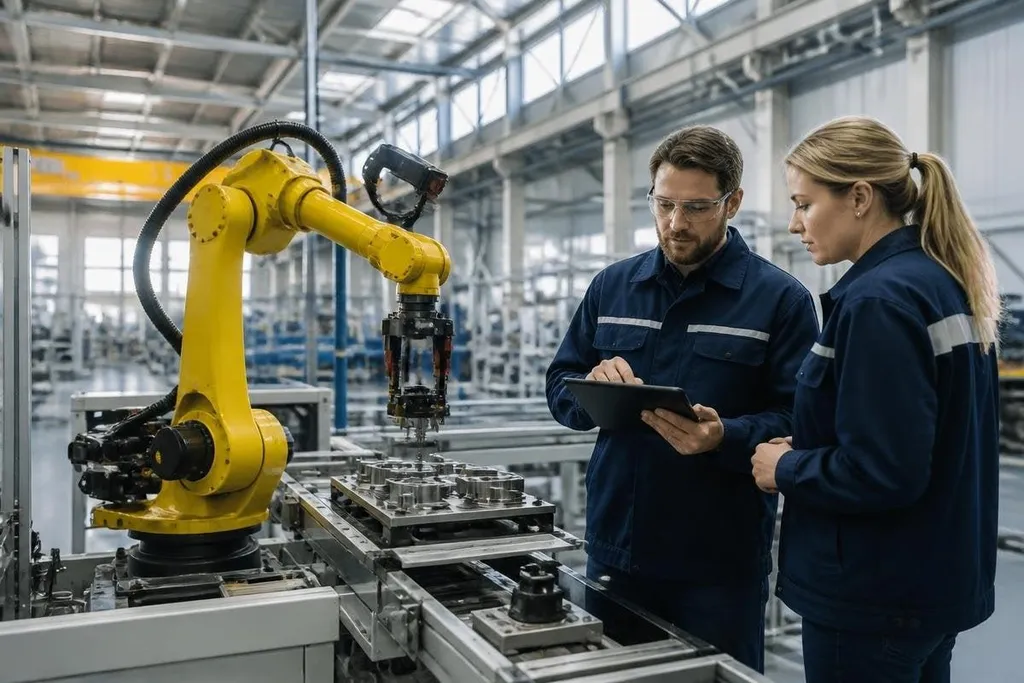
Robots now do more than single-purpose jobs. Their systems affect factories, warehouses, farms, hospitals, and public services. That shift makes robotics a business planning issue, because a machine can change how work is done, where products are made, and which skills a team needs.
Quick read
- Robots now combine sensors, motors, software, and remote control in one work system.
- The main question is fit: can the machine repeat a useful task safely at the needed cost?
- Companies need plans for staff training, maintenance, data, and spare parts before buying hardware.
The machine is only one part
A robot arm may lift a box, weld a joint, or sort a parcel. Its value depends on the full setup around it: the gripper, cameras, safety scanners, software, power supply, floor space, and people who keep it running.
That changes the buying decision. A factory may need a robot that handles one shape all day, while a warehouse may need a system that finds different items and changes its route when a shelf moves. The same robot can fit one site and fail at another because the work is different.
This is why robotics belongs in operations planning, not only in an engineering budget. Leaders need to map the task first, then choose the machine.
Automation changes the shape of work
Robots take on tasks that are repetitive, heavy, dirty, or placed near moving equipment. People still set goals, handle exceptions, check quality, repair faults, and change the process when demand shifts.
That split affects training. A team may need fewer hours spent on manual movement and more time spent reading sensor alerts, checking tools, or fixing software settings. A company that buys the robot without preparing the team has bought a machine, not a working process.
The change can also reach suppliers. If a robot depends on a certain camera, motor, battery, or control board, a shortage can stop the line. Spare parts and repair skills become part of the business plan.
Why governments and companies care
Robotics can affect production capacity, workplace safety, transport, food supply, and medical care. Those areas connect machines to public policy and national industry plans, even when the first deployment happens inside one private site.
A country that builds robots also needs people who can design motors, write control software, make sensors, test safety systems, and service machines in the field. Those skills support other industries too, since the same parts and methods can appear in factory automation, mobile robots, and autonomous systems.
For a company manager, the practical question is smaller: which task has a clear cost, a repeatable motion, and a safe way to measure results?
A cost claim needs a named machine, task, and site before it can guide a purchase. Dated robotics deployment reporting gives you those details, so the next section can test where the hardware still falls short.
The limits are still practical
Robots work best when the task, workspace, and input stay within known limits. A camera may lose a part under glare. A gripper may slip on a soft package. A mobile robot may stop when people, pallets, or cables block its route.
These cases don't make automation pointless. They set the work needed before a purchase: test the task with real parts, record failure cases, measure how often a person must step in, and price maintenance alongside the machine.
Claims about flexible robots need the same check. A video can show that a robot completed one task. It can't show how the system performs across a full shift, after a tool change, or when the floor and lighting differ.
A buying check for managers
Use this list before approving a robotics project:
- Name the task: Write down the exact motion, object, speed, and handoff.
- Measure the baseline: Record labor time, error rates, stoppages, and injury risks.
- Test real inputs: Run the system with the parts, packaging, lighting, and floor it will face.
- Plan the exceptions: Decide who handles jams, failed grasps, sensor faults, and safe stops.
- Price the full system: Include tools, software, training, power, service, and spare parts.
- Set a stop rule: Define the result that keeps the project running and the result that ends it.
I’d treat robotics as a long-term operating choice, not a single equipment purchase. The companies that gain from it will be the ones that can name the task, measure the result, and support the system after the demo ends.
The next test is simple: can the robot keep doing useful work when the parts, people, and floor stop behaving perfectly?